

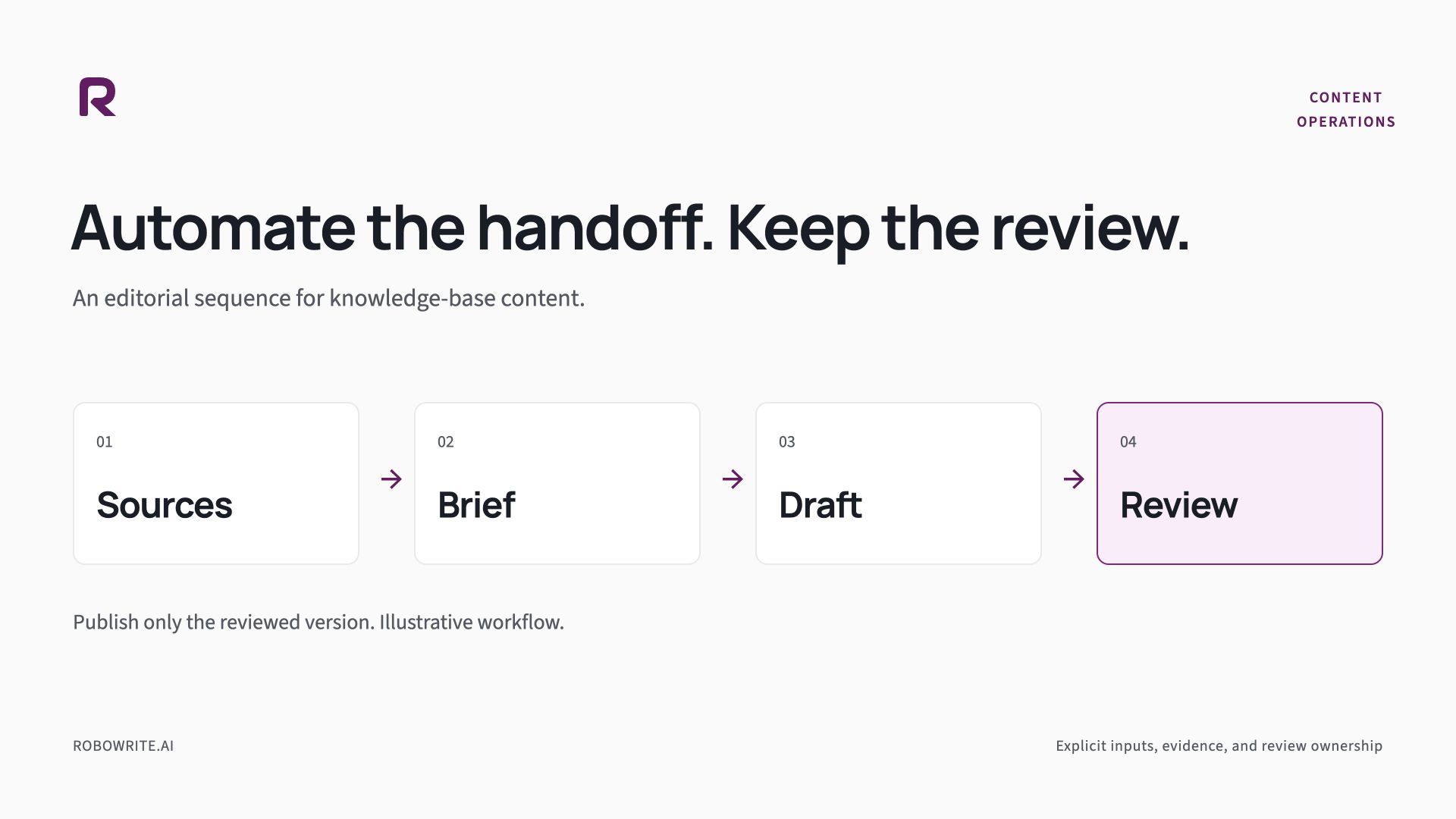
A repeatable SEO content workflow moves through distinct decisions: choose the audience question, review related keywords, define a brief, gather evidence, inspect the Content Kit, draft, and review. Publishing and performance review follow after the copy is approved.
The stages help a SaaS founder keep control of scope and facts while using AI to develop a draft. Each stage should leave an artifact that makes the next decision easier. A saved draft is not the same as a published page or a measured result.
Start With One Buyer Question
For an illustrative example, consider a small SaaS team's customer-onboarding preparation. The reader needs to gather information and assign responsibilities before the first onboarding session.
Review related queries, then decide which ones belong in the same answer. Preparation and handoff requirements may fit together. Software comparisons and measurement definitions may need separate pages. The example is an editorial scenario, not measured keyword demand or a tested production run.
Check existing content before creating another URL. If a useful preparation guide already exists, update it. A different keyword order is not a reason to produce another page with the same purpose.
Make the Brief a Decision Document
Record the reader, intent, central question, required coverage, exclusions, evidence requirements, voice, and useful next step. Give each section a specific job.
For the onboarding example, the outline might explain the handoff, gather customer inputs, assign internal owners, handle missing information, and review the preparation checklist. Product rankings, invented customer stories, and unsupported timing claims are outside that assignment.
Keep structure flexible where it improves the answer. A writer can propose a clearer heading without changing the reader's task. A new claim or a new product comparison needs review because it changes the evidence burden.
Gather Evidence Before Requesting Strong Claims
Use current product information for product facts. Keep supplied expertise and attribution distinguishable from externally supported claims. Record relevant source URLs and the statement each page supports.
The planned Firecrawl and Perplexity connections can be described only within their released scope. Until availability is verified, do not present their setup or results as a tested part of the example. Perplexity's planned connection is Search API discovery, not Deep Research.
Research results are candidates for review. A snippet, a familiar domain, or a long source list does not prove a statement. When evidence is missing, narrow the claim, find a suitable source, or change the assignment.
Review the Content Kit Before Drafting
RoboWrite's Content Kit brings together an outline, supporting claims, and selected components. The brief can express coverage and element requirements. Choose those elements because they serve the answer, not because every article should have the same collection.
For this example, the useful choices may be a clear outline, takeaways, and an optional FAQ. A quotation needs eligible attributed material. A statistic needs a relevant dataset. A software comparison table is unnecessary for the preparation question.
Modes vary by element: citations are Required or Optional; the steps component is currently off; a comparison table is Optional or Off. A missing required element or source can leave the kit waiting for review. An approval or waiver does not create factual evidence.
Draft and Review as Separate Stages
Use the approved direction to develop the article. Read the saved draft against the brief, supporting sources, and current product details. Check whether every section helps the intended reader and whether the prose introduces unsupported specifics.
For revisions in your own editor, work section by section when that makes review easier. Do not describe this manual technique as a promise that RoboWrite provides a particular section-generation control in every surface.
A source check, a style review, and publication approval answer different questions. Keep a visible correction list. If the version is partial or held, resolve the relevant findings before presenting it as ready.
Use This Workflow Record
Copy the table into a document or project tracker. One person may own several stages, but each stage still needs a clear completion check.
| Stage | Output to keep | Review decision |
|---|---|---|
| Audience and keyword review | Reader, main question, cluster, existing-page check | Does one useful page serve this task? |
| Brief | Scope, coverage, exclusions, outline, next step | Is the assignment clear enough to evaluate? |
| Evidence | Facts, attribution, URLs, relevant passages | What can the article actually claim? |
| Content Kit | Selected elements and visible review findings | Are requirements useful and supportable? |
| Draft | Complete saved article version | Does the prose fulfill the reader's task accurately? |
| Publication | Approved copy, destination, live check | Does the live page match the approved version? |
| Performance review | Available queries, visits, useful actions, decision | What should be retained or improved next? |
This is a working record, not a product scheduling feature or a claim about turnaround time.
Finish the Page Before Measuring It
Prepare accurate metadata, descriptive headings, relevant internal links, and accessible supporting media. Check the actual links and the public page. Put the main answer where readers can find it quickly.
Google says existing SEO fundamentals also apply to its AI search features. That does not mean a Content Kit, a FAQ, a source list, or a particular layout guarantees inclusion in an AI answer.
Record the publication date, page purpose, and baseline. Separate search impressions, clicks, AI-referral visits, sampled citations, and product actions. If the page attracts the wrong audience, reconsider the intent before producing more pages in the same pattern.
Define What Happens When the Source Is Missing
An automated handoff needs an understandable hold condition. The reviewer should be able to distinguish an absent source, an outdated source, an unsupported claim, and a source that answers a different question.
| Situation | Keep visible in the handoff | Appropriate next action |
|---|---|---|
| The product document describes an older release | Document version and the affected claim | Ask the product owner for current evidence |
| A customer story has no approved quotation | The research note and quotation requirement | Provide approved wording or revise the unnecessary requirement |
| Two pages appear to own the same task | Both URLs and their intended reader decisions | Review overlap before creating another URL |
| Generation timed out after starting work | The request identity and any saved draft | Inspect the actual result before retrying |
Keep the approved brief and the draft it produced identifiable. A revision to the audience, product facts, or source requirements can change the assignment; an older approval does not validate that new assignment automatically.
The content brief automation workflow develops this handoff for knowledge-base teams with a worked source-to-brief example. Use it to define responsibility and acceptance checks, while verifying your actual publishing tools separately.
Next Step
Explore the SaaS founder content workflow, then start with one reviewed cluster and one brief. Confirm supported publishing before signup; Strapi is the supported CMS integration today.
Sources and Further Reading
- Google's AI-features guidance.
- Google's generative-AI content guidance.
- RoboWrite Public API guide: current workflow, Content Kit, and publishing contracts.